
Resource — overview
FACILITATION FRAMEWORKS AND TOOLS
Frameworks are useful as far as they help a room think — and no further. A framework that makes a group's reasoning visible and shared is doing its job. A framework that mainly demonstrates the facilitator's methodology is costing the session time it needed elsewhere.
What a framework is for
SHARED STRUCTURE, NOT A SHOWCASE.
A framework gives a group somewhere agreed to put its thinking. That's the whole value: it tells everyone what we're doing now, what counts as an answer, and how this connects to the next step.
Which is why the same framework can be excellent in one room and a waste of forty minutes in another. It depends entirely on whether the group needed that particular structure to make progress. The question to ask before using one is never "is this a good framework" — it's "what does this room need that it can't do without a structure".
Almost everything in the categories below is a variation on a handful of moves: think before you speak, compare against stated criteria, make the decision rule explicit, and write things down where everyone can see them.
Categories that exist
THE BROAD TYPES, IN PLAIN TERMS.
Not a definitive list, and deliberately generic — there are dozens of named variants of each, and the names matter far less than the mechanic underneath.
Structured ideation methods
Formats that get ideas out before they get judged — individual writing first, round-robin capture, building on someone else's idea in a defined order. Whatever the name, the mechanic is the same: separate generating from evaluating so the first confident voice doesn't set the ceiling.
Prioritisation matrices
Two-axis grids that force a group to compare things on stated criteria — effort against impact, urgency against importance, cost against value. Useful because the argument moves from 'which do you like' to 'where does this sit', which is a much easier disagreement to resolve.
Decision-making frameworks
Structures that make explicit how a decision will be made and by whom before the discussion starts — who decides, who is consulted, what happens if there's no consensus. Most decision meetings fail on this rather than on the analysis.
Retrospective formats
Simple prompts for reviewing what happened — what worked, what didn't, what we'd change. The format matters far less than whether people will say the true version out loud, which is a facilitation problem rather than a tooling one.
Visual capture
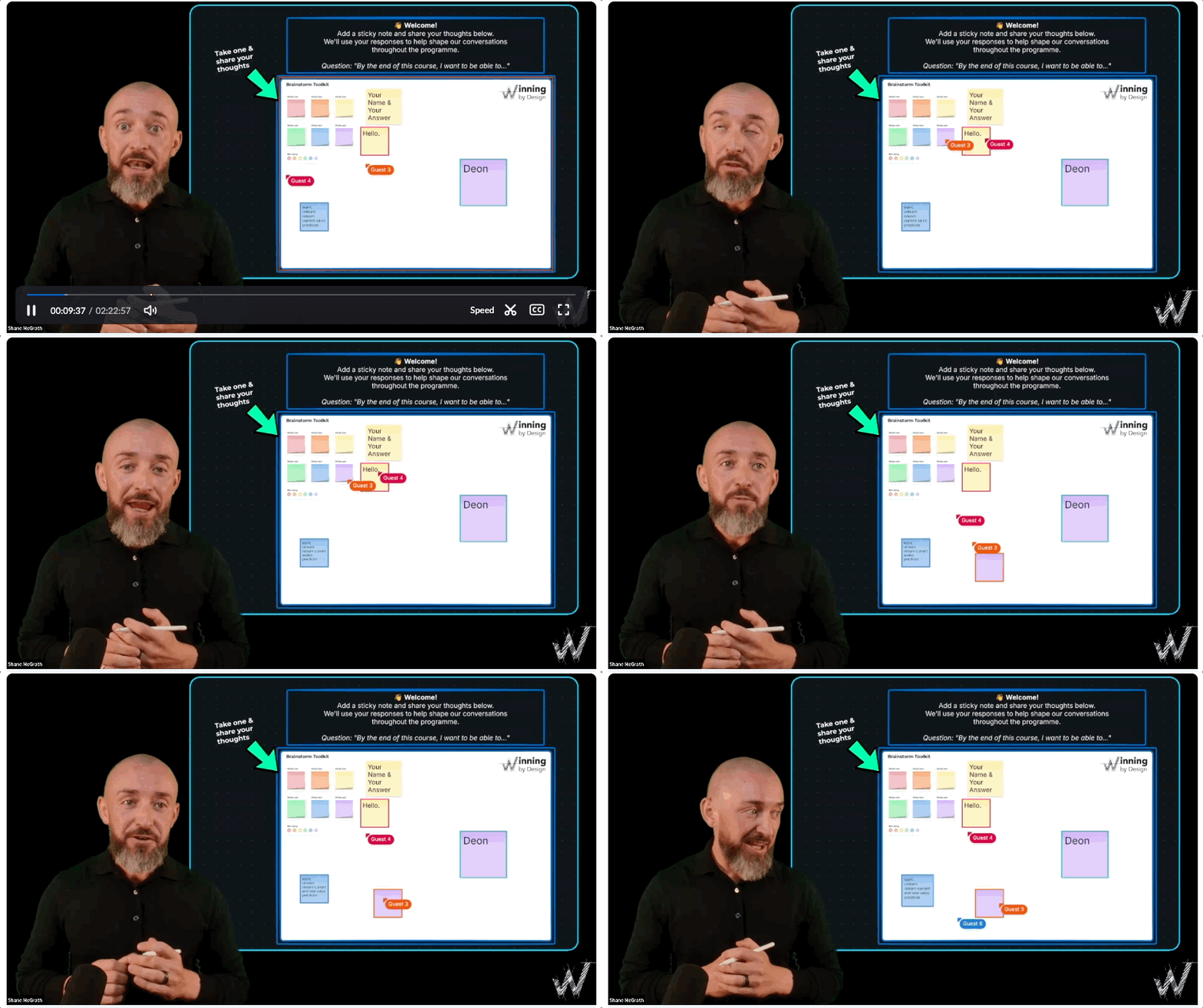
Whiteboards, flipcharts and shared online canvases. Their real function is memory: a group can only build on thinking it can still see. This is the most under-used tool in most sessions and the least fashionable.
The risk
IF IT SOUNDS CLEVER, IT'S PROBABLY TOO COMPLICATED.
Framework-first facilitation starts from the method and looks for a room to use it in. It's seductive because it feels like expertise, and because a clever technique is easier to talk about than a well-judged simple one. But when a technique sounds impressive, that's usually a sign it's more complex than the room needs — and complexity always gets paid for out of the group's thinking time.
Rooms generally already hold the knowledge and context required. The facilitator's job is to let that surface, not to dominate it with process. The test we'd apply to any framework: could you explain it in a sentence, and does the group produce something they'll still use tomorrow? If not, do something simpler — the simplicity is not a compromise, it's the point.
Questions
COMMON QUESTIONS.
Keep reading
RELATED READING.
Designing a workshop
Design backwards from the outcome — where a framework should and shouldn't sit.
Engagement techniques
Well-established techniques for getting real participation, without the branding.
All resources
Guides on facilitation craft, workshop design, delivery skill and making it stick.
TOOLS DON'T MAKE A FACILITATOR.
Facilitation training builds the judgment that decides when a structure helps a room and when it gets in the way — practised in real sessions, not collected from a toolkit.